VAT, audits & proof
Split VAT Rates on One Receipt, Non-Deductible VAT & Duplicate Export Prevention in France
Claire, who handles admin and finance for an advisory SME splitting time between Paris and Fort-de-France, thought exporting expenses twice a month would keep cash flow tidy. Come late October, her chartered accountant flagged three headaches in one month alone: twenty client lunch bills booked flat at 10% despite 20% wine on the slip, three hotel stays where input VAT was wrongly reclaimed, and six early-October tickets imported twice into the general ledger.
An audit magnet.
Any basic scanner handles a single-rate 20% invoice. The second real-world French tax rules hit — a split-rate bistro receipt, an employee hotel bill, a Martinique ticket at 8.5%, or staggered monthly CSV exports — generic spreadsheets collapse fast. Here is how to automate those four edge cases cleanly without becoming a French CA3 tax specialist.
French restaurant receipts with 10% and 20% VAT: how to split them without errors
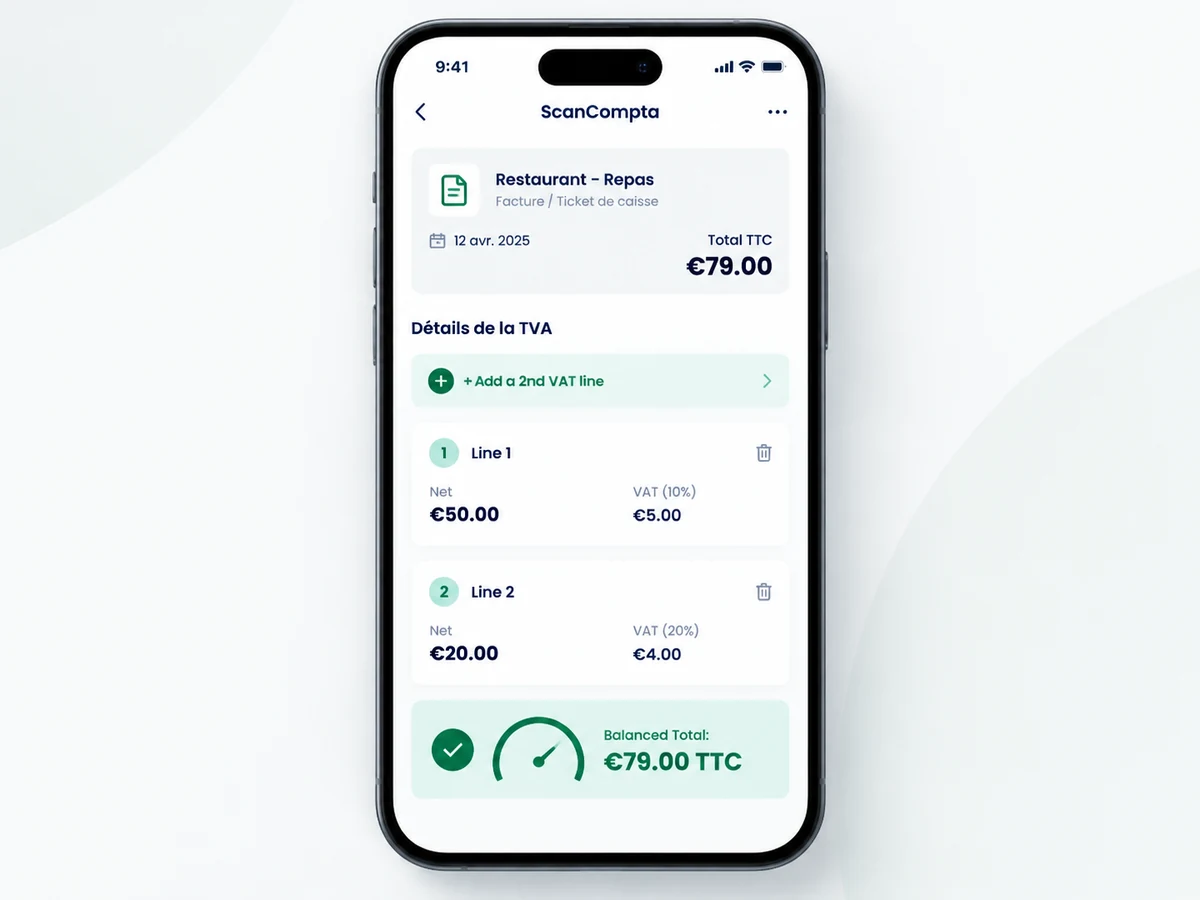
Quick answer: On French restaurant receipts, food and soft drinks carry 10% VAT, while alcoholic drinks carry 20% VAT. Lumping the total under one rate skews your CA3 VAT filing. ScanCompta's "+ Add a 2nd VAT line" feature validates `(Net 1 + VAT 1 + Net 2 + VAT 2 = Total TTC)` and writes two clean VAT ledger rows.
Every business owner running expenses in France knows that crumpled paper moment.
You take a client to lunch: two set menus, sparkling water, two espressos — plus two glasses of wine. Down at the bottom, the card terminal prints two separate tax lines: 10% on the food, 20% on the alcohol. Dump the entire €79.00 total into a 10% column, or divide blindly by `1.10` in Excel, and your trial balance stops matching your actual VAT return.
French tax inspectors and automated firm review tools spot distorted input VAT ratios immediately. Make sure you also review our French business meals URSSAF rules and dedicated overview of handling multiple VAT rates on a single receipt.
Walk through a concrete €79.00 incl. VAT (TTC) lunch slip:
- €55.00 incl. VAT for food and non-alcoholic drinks at 10% (€50.00 net + €5.00 VAT).
- €24.00 incl. VAT for wine at 20% (€20.00 net + €4.00 VAT).
Inside ScanCompta, clicking "+ Add a 2nd VAT line" solves this in two seconds. Enter — or let the AI parse — the 10% slice and the 20% slice side by side. Before saving, the platform runs a strict balance check:
`(€50.00 + €5.00) + (€20.00 + €4.00) = €79.00 TTC`
If the math misses the grand total by even one cent, a clear alert stops bad data from saving. And when your CPA runs the Debit/Credit journal export, ScanCompta writes two accurate lines into account `445660` (€5.00 and €4.00) with zero manual calculator work.
When VAT isn't recoverable (employee hotels, rail, gifts): applying the Gross-to-Net rule
Quick answer: Even when a receipt visibly prints VAT (employee hotel rooms, SNCF rail tickets, passenger cars), French tax law frequently bars recovery. Bookkeeping must post the full VAT-inclusive total as expense (`Net = Total`). Unticking "Deductible VAT" in ScanCompta flips the entry automatically.
Honestly, this causes more accidental tax adjustments than almost anything else in French bookkeeping.
Plenty of managers assume: "It says 10% VAT right there on my hotel bill and TGV receipt, so we can claim it back!" Wrong. Completely wrong.
Under French VAT law, seeing VAT printed on an invoice never grants an automatic right to deduct it. As set out in Article 206, Annex II of the French General Tax Code (Légifrance) and administrative doctrine in BOFIP (impots.gouv.fr), several everyday travel expenses stay strictly blocked:
- Employee and director hotel accommodation: input VAT on the overnight room charge (10%) cannot be recovered by the company — only separately itemised breakfast or restaurant meals qualify.
- Passenger transport tickets: SNCF rail tickets, domestic flights, metro passes, taxis, and Uber rides carry zero VAT deduction right for the client business.
- Passenger vehicles and fuel nuances: rules diverge sharply between commercial vans and passenger cars across diesel and petrol — double-check our breakdown on VAT on fuel and highway toll receipts before closing your quarter.
- Client gifts: apart from very low-value promotional items (€73 incl. VAT per recipient per year threshold), input VAT on business gifts stays non-deductible.
Here's the accounting rule: non-recoverable VAT becomes an operating cost. The full gross amount (`TTC`) must hit Class 6 expenses, with €0.00 posted to `445660`.
In ScanCompta, there is no manual math to redo: just untick "Deductible VAT". On a €110.00 gross hotel room receipt, net expense immediately switches to €110.00, recoverable VAT drops to €0.00, and no `445660` row ever reaches your CPA's ledger export. Zero guesswork. Zero compliance exposure.
French Overseas Territories (DROM-COM) & Corsica: handling territorial VAT rates natively
Quick answer: Businesses operating in French Overseas Departments or Corsica apply statutory territorial VAT rates: 8.5% and 2.1% in Martinique, Guadeloupe, and Réunion; 13%, 10%, 2.1%, and 0.9% in Corsica. ScanCompta builds every territorial rate plus a custom rate field right into the scanner.
Spoiler: 90% of US expense software — and surprisingly many French apps — hardcode four Mainland rates (`20%`, `10%`, `5.5%`, `2.1%`) and call it a day.
Try logging a business lunch from Pointe-à-Pitre, hardware supplies from Fort-de-France, or a service station bill from Réunion inside one of those rigid tools. Impossible. Either the tool forces a wrong Mainland percentage or makes you reverse-engineer net figures in a spreadsheet.
Here are the statutory rates outside Mainland France published by impots.gouv.fr:
- Guadeloupe, Martinique, and Réunion: standard rate is 8.5% and reduced rate is 2.1% (plus niche special rates such as 1.75% and 1.05% for specific goods and press).
- French Guiana and Mayotte: VAT does not apply locally — expenses book cleanly at gross total without VAT recovery.
- Corsica: alongside the Mainland 20% standard rate where applicable, statutory territorial rates cover 13% (notably petroleum products), 10% (building work, dine-in catering, transport), 2.1%, and 0.9%.
- Foreign business trips: receipts incurred abroad (Germany 19%, Spain 21%, UK 20%, Switzerland 8.1%) cannot go onto your regular domestic CA3 deduction box — they require either cross-border refund procedures or gross expense treatment.
ScanCompta's rate dropdown natively includes Mainland rates, French Overseas rates (8.5%, 2.1%), Corsican rates (13%, 10%, 2.1%, 0.9%), and a custom free-rate field so non-Mainland receipts never block your team.
No more duplicate entries at your CPA: export expenses smoothly without double-counting
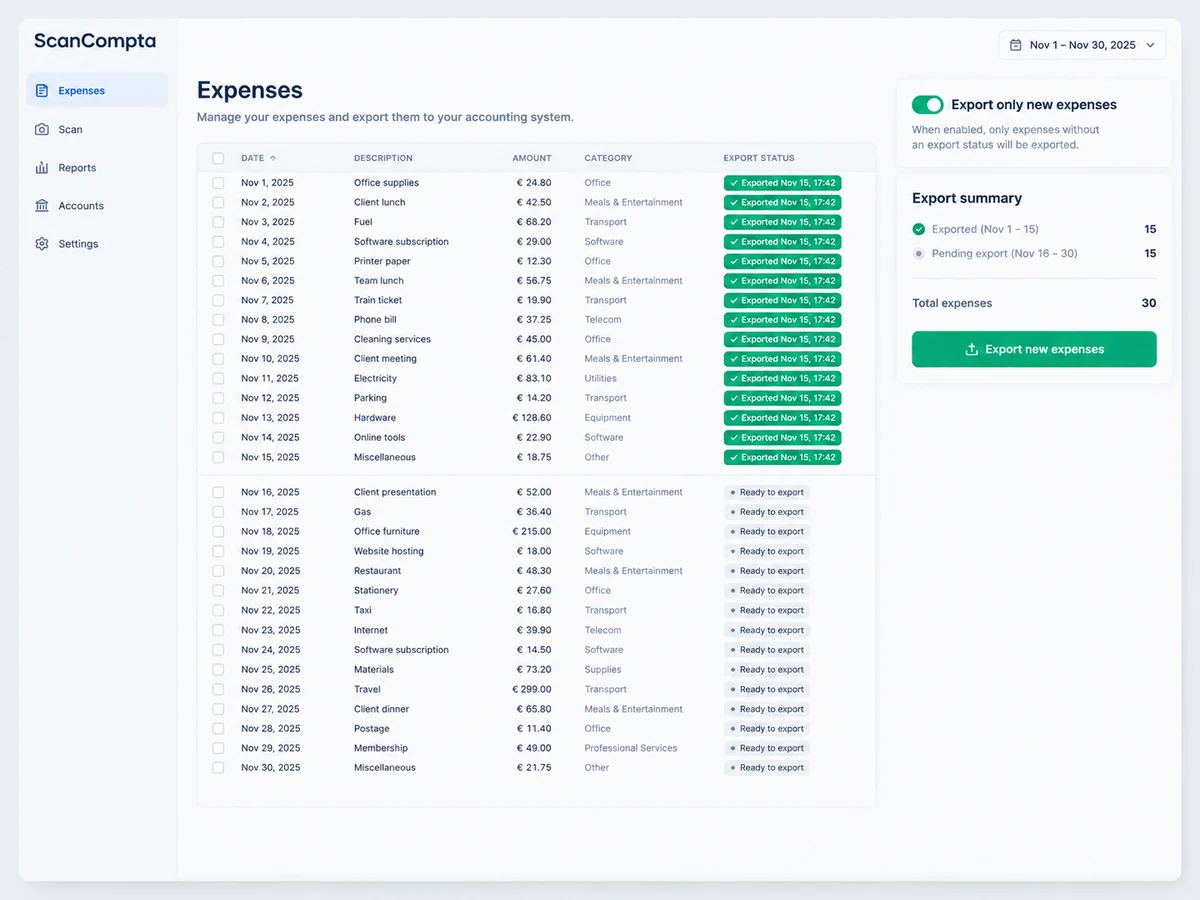
Quick answer: Exporting a CSV on the 15th and re-exporting the full month on the 30th double-counts the first two weeks. ScanCompta stamps every exported item with a timestamped `✓ Exported` badge and gives you a one-click "Export only new expenses" filter.
Every conscientious manager hits this trap sooner or later.
You try to stay ahead of admin. On the 15th, you send your accountant a mid-month export so cash flow forecasts stay fresh. Then on the 30th — juggling payroll, client invoicing, and month-end deadlines — you filter "Full October" and email a second export file.
What happens next? Your firm's bookkeeper posts the 1st–15th receipts twice. Expenses double overnight. Reclaimed input VAT inflates falsely. And you lose an evening reconciling bank rows line by line — made worse if someone assumes bank lines suffice, whereas in France a bank statement cannot replace an original receipt and even French sole traders must retain compliant receipts.
To eliminate duplicate accounting receipts once and for all, ScanCompta enforces four built-in safeguards:
- Timestamped `✓ Exported` status badge: the instant a receipt enters a CSV or balanced Debit/Credit export, it picks up a clear green badge recording the exact date and time of transmission.
- One-click "Export only new expenses" filter: on the 30th, run your export across the whole month without worry — only receipts scanned since the 15th leave the system.
- Instant visual status across teams: managers immediately spot which tickets are still waiting for export versus items already sent to the accounting firm.
- One-click export status reset: edited a category or fixed a guest name on a previously exported meal, or need to regenerate a full quarter for your CPA? Reset a single row or batch back to unexported in one click.
Article written in accordance with French General Tax Code rules (CGI Annex II Art. 206, DROM and Corsican VAT provisions) in force as of 16 November 2026. Always confirm edge cases with your chartered accountant.
Stop letting split restaurant VAT, overseas rates, and double exports derail month-end close. Snap your complex receipts and download a duplicate-free journal today.
The stray-receipt challenge
Curious how the AI handles it? Take a photo of the receipt lying on your desk and test the extraction in 2 seconds, no account needed.
Try the scan live
No account needed. Nothing is stored.
No account needed. Nothing is stored.
Frequently asked questions
Why do French restaurant bills often have both 10% and 20% VAT?
In France, dine-in food and non-alcoholic drinks are taxed at 10%, while alcoholic drinks are taxed at 20%. Both tax bases must be recorded separately so your CA3 VAT filing stays accurate.
Can a French company recover VAT on an employee hotel room?
No. Under Article 206, Annex II of the French General Tax Code, lodging VAT for employees and company directors is non-deductible (`Net = Total`). Separately itemised breakfast or dining VAT remains deductible.
Which special VAT rates apply in French Overseas Departments (DOM) and Corsica?
Guadeloupe, Martinique, and Réunion use 8.5% (standard) and 2.1% (reduced), while French Guiana and Mayotte do not apply VAT. Corsica applies territorial rates of 13%, 10%, 2.1%, and 0.9%.
How do you stop duplicate entries when exporting mid-month and month-end?
In ScanCompta, exported items carry a timestamped `✓ Exported` badge. Leaving "Export only new expenses" enabled ensures previously transmitted receipts are skipped automatically on subsequent exports.
Test ScanCompta's OCR with your own receipts
Snap a crumpled receipt, a fuel invoice or a restaurant bill: the AI extracts the date, the amount and the VAT in two seconds. 5 free scans a month, no card required.

About the team
The ScanCompta team
ScanCompta designs simple tools to help French freelancers, tradespeople and self-employed professionals manage expense reports and accounting receipts effortlessly.
Discover ScanCompta →Questions & comments
A question about this guide? Ask below — I answer personally within one business day.
- J
Julien
If I lose a €9 toll receipt, can I still claim it with just a bank statement?
ScanComptaAuthorYes — for a small amount, a bank statement plus a signed statement is usually accepted. You cannot reclaim VAT without the original receipt though.
- S
Sonia
Do I need to keep the paper receipts after scanning them with your app?
ScanComptaAuthorNo. If the scan is a faithful and durable copy, the digital version is enough. We store everything for 10 years for you. Order of 22 March 2017 on reliable copies