Accounting
French Accounting Codes for Expense Reports: Complete PCG Guide (625, 445660, 421)
Friday evening, 7:30 PM. Marc, who runs an industrial maintenance SME in Toulouse, opens an email from his bookkeeper. Three rows flagged in red. "Please confirm whether this €68 Total fuel receipt belongs in 625100 or 606100 — and why four brand-new 401 supplier accounts were created for local brasseries."
Sound familiar?
Nobody starts a business to spend Friday nights memorising six-digit numbers from the French Plan Comptable Général (PCG). Yet the moment your team begins travelling, taking clients to lunch, or paying with corporate cards, knowing the right French accounting codes for expense reports changes everything. Better yet, it stops your firm from billing extra hours to reclassify messy entries before filing your annual FEC audit file.
What are the official French PCG accounting codes for each expense category?
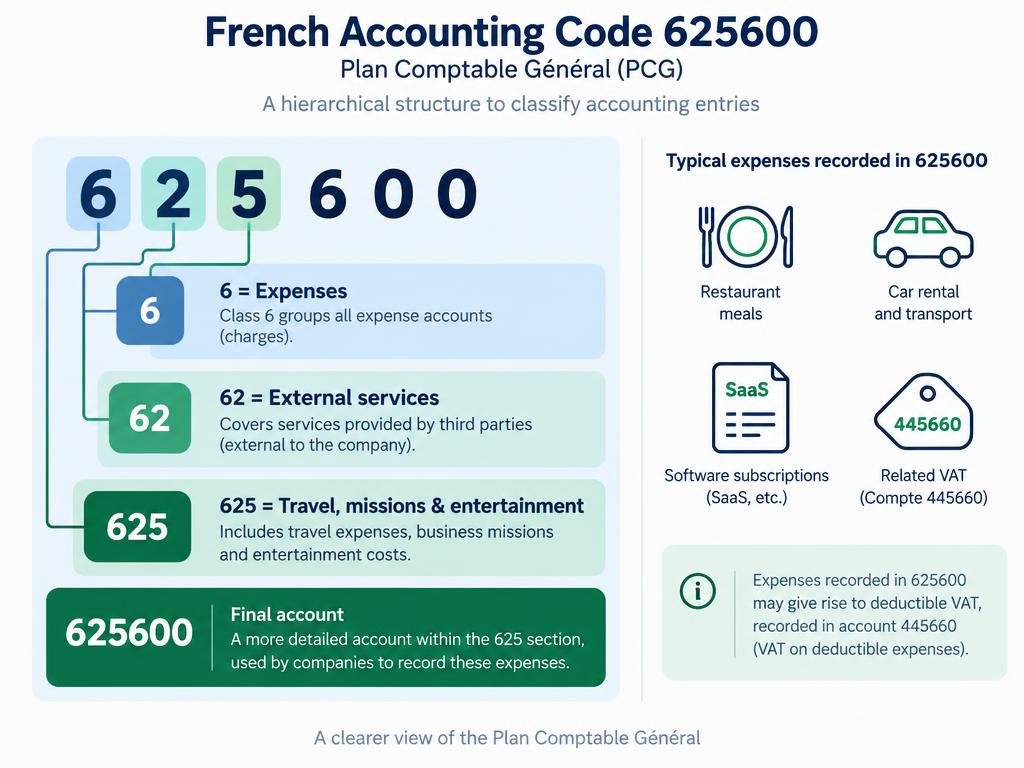
Quick answer: Under the French General Chart of Accounts (PCG), expense reports mostly use the 625 root: 625600 for restaurant meals and client entertainment, 625100 for fuel and travel, 606400 for office supplies, 613500 or 651000 for SaaS subscriptions, and 445660 for recoverable VAT.
Before diving into individual digits, let's get one thing straight. While the French Accounting Standards Authority (ANC) sets the statutory Plan Comptable Général framework, every chartered accounting firm customises its trailing digits. Some firms stick to 6 digits (625100), while others pad to 8 digits (62510000) for granular cost tracking.
The core account roots never change, though. Below is the exact mapping table used across virtually every Sage, Cegid, EBP, and ACD setup in France:
| Expense report category | Expense ledger code (PCG) | Standard French accounting usage | VAT recovery (account 445660) |
|---|---|---|---|
| Restaurants & client entertainment | 625600 (or 625700) | Missions et réceptions (client lunches, business travel meals) | Yes, provided guest names and business purpose are documented |
| Fuel, rail, flights & travel | 625100 (or 606140 for fuel) | Voyages et déplacements (transport and fuel outside fleet stock) | Yes on fuel (80% / 100% rules); no on passenger rail or air tickets |
| Hotels & short-term rentals | 613500 or 625100 | Locations mobilières / business mission accommodation | No on employee/director room nights; yes on separately itemised breakfast |
| Office supplies & small equipment | 606400 (or 606300) | Fournitures administratives / small tools under €500 excl. VAT | Yes, 20% upon presenting a compliant VAT invoice |
| Highway tolls & parking | 625100 or 625600 | Road tolls and professional parking fees | Yes (20%), provided business travel context is retained |
| Software & SaaS subscriptions | 651000 or 613500 | Software licences and cloud subscriptions | Watch out for reverse-charge VAT on foreign software |
| Deductible VAT on goods & services | 445660 | TVA déductible sur autres biens et services (ABS) | Collects all recoverable input VAT from general operating expenses |
Honestly, restaurant meals cause more confusion than almost anything else. Founders routinely mix up solo travel meals (625100 / 625600) with client entertaining (625700 Réceptions). If you aren't sure what social security inspectors accept, review the URSSAF rules on business meals before closing your quarter.
On the road, fuel and motorway charges are another classic minefield — especially with the rules governing VAT on fuel and highway tolls across petrol, diesel, and hybrid vehicles. Getting the mapping right from day one keeps your French CA3 VAT return clean.
The 401 supplier trap: why use one subsidiary ledger per employee or corporate card (421 / 401)?
Quick answer: Opening a separate 401 supplier account for every bakery, toll booth, or petrol station makes your trial balance unreadable. French accounting firms book all expenses into a dedicated journal (NDF or HA) against one subsidiary ledger account per employee (421-DUPONT) or company card (401-CARTE-01).
This is the number-one rookie mistake made by small business owners setting up their own pre-accounting workflow.
Picture a field rep buying a sandwich on the motorway on Monday, refuelling at TotalEnergies on Tuesday, and taking a client to dinner on Thursday. If you generate a separate 401 supplier code for every vendor — 401SANDW, 401TOTAL, 401BRASS — your supplier balance explodes. By December, your CPA is staring at 450 bloated supplier accounts used once and never touched again. A reconciliation nightmare.
During a conversation with a 12-person chartered accounting practice in Lyon, a senior manager told us she wasted nearly four hours per SME file just merging stray 401 accounts created inside a generic purchases journal. Here's the thing: you don't owe the brasserie money — they were already paid at the till!
Instead, seasoned French accounting firms follow a clean, predictable structure:
- Dedicated expense report journal (NDF or OD): whenever an employee or sales rep pays out of pocket, the expense hits Class 6 plus VAT (445660), while the credit lands on a single personal employee ledger such as 421-DUPONT (or 455-DIRECTOR for an owner-manager's current account).
- Dedicated corporate card journal (HA or CB): when expenses are paid with a company debit or credit card, every receipt credits one dedicated card ledger — such as 401-CARTE-01 or 401-CB-MARTIN — rather than creating hundreds of vendor records.
- One-line reimbursement clearing: when payroll reimburses the employee through the bank journal (BQ), a single debit to 421-DUPONT settles all thirty receipts for that month in one stroke.
- Clean supplier master file: your real 401 accounts stay strictly reserved for recurring suppliers — rent, insurance, telecoms, subcontractors — who issue formal invoices with payment terms.
And just in case you thought the corporate card line on your bank feed was enough to satisfy an inspector: it isn't. Read why a bank statement is not valid accounting proof on its own under French tax law.
How do you turn a scanned receipt into a balanced Debit / Credit journal entry?
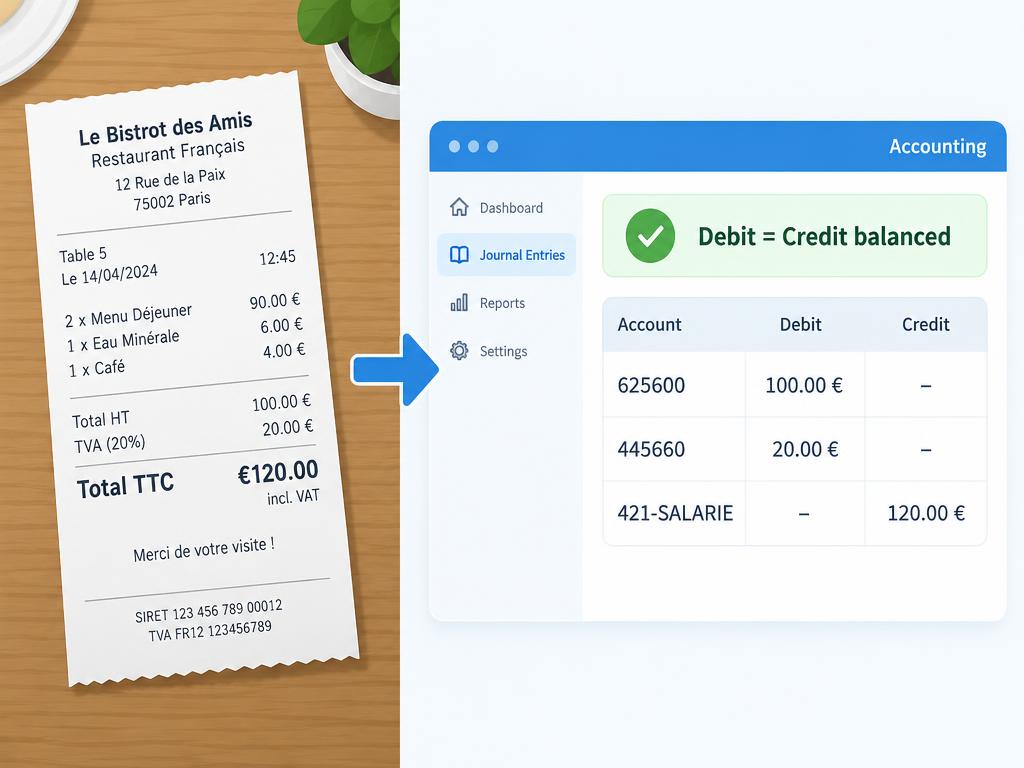
Quick answer: Unlike a flat spreadsheet listing one column per amount, a true general ledger journal builds balanced double-entry lines where Total Debit equals Total Credit. A €120 VAT-inclusive restaurant bill (€100 net + €20 VAT) generates three rows: 625600 (€100 Dr), 445660 (€20 Dr), and 421-SALARIE (€120 Cr).
Plenty of scanning apps claim they "handle your bookkeeping." What they actually hand you is a flat CSV table — date, vendor, amount — leaving your accountant to convert every single line into double-entry bookkeeping rows before importing into Sage, Cegid, EBP, or ACD.
Because in accounting, one rule overrides everything else: Total Debit must equal Total Credit. No exceptions.
Let's walk through a real, exact-cent example. Julie, a commercial director at a consulting SME in Nantes, pays €120.00 incl. VAT (TTC) for a client working dinner subject to 20% VAT for clarity (€100.00 excl. VAT / HT and €20.00 VAT). She pays with her personal card and scans the receipt under journal NDF linked to subsidiary code 421-SALARIE.
Here is the balanced general ledger entry generated straight from that single scan:
| Journal | Date | General account | Subsidiary / tier | Entry description | Debit (€) | Credit (€) |
|---|---|---|---|---|---|---|
| NDF | 2026-11-12 | 625600 | — | Client dinner — Brasserie Le Molière | 100.00 | 0.00 |
| NDF | 2026-11-12 | 445660 | — | Recoverable VAT 20% — Brasserie Le Molière | 20.00 | 0.00 |
| NDF | 2026-11-12 | 421000 | 421-SALARIE | Expense claim — Julie M. | 0.00 | 120.00 |
| Total | Balanced entry verified | 120.00 | 120.00 |
Three lines. Zero rounding mismatch. Ready for direct ledger import.
Now, what happens if Julie pays €120.00 incl. VAT for a hotel room — even though the hotel invoice visibly prints 10% VAT? Under Article 206, Annex II of the French General Tax Code (Légifrance), VAT on accommodation provided to company directors and employees is strictly non-deductible.
Posting that hotel VAT to 445660 is an instant red flag during a DGFiP tax audit. In a smart accounting export, unticking a single "Deductible VAT" checkbox rewrites the entry cleanly:
| Journal | Date | General account | Subsidiary / tier | Entry description | Debit (€) | Credit (€) |
|---|---|---|---|---|---|---|
| NDF | 2026-11-12 | 625100 | — | Hotel stay business travel — Lyon | 120.00 | 0.00 |
| NDF | 2026-11-12 | 421000 | 421-SALARIE | Expense claim — Julie M. | 0.00 | 120.00 |
The 445660 VAT row vanishes completely. Pre-tax charge equals the full €120.00 paid. Zero manual adjustments needed by your CPA at month-end.
How do you set up accounting codes once in ScanCompta (or hide them if you work solo)?
Quick answer: In ScanCompta, businesses map their custom categories to expense and VAT ledger codes once, alongside journal and subsidiary tier codes per folder. Exports support either "Raw Data" columns or a balanced "Debit/Credit Accounting Journal," while solo freelancers can keep a simplified label-only view.
Let's be real for a second.
If you are a solo consultant or French auto-entrepreneur without VAT registration or accrual bookkeeping, staring at 625600, 445660, and 421-SELF every time you snap a parking ticket is complete overkill. That is why we refused to force heavy general-ledger terminology onto every user screen.
Inside ScanCompta, the interface adapts automatically to your business setup — and scales whenever you hire or incorporate:
- Simplified mode for solo freelancers: you work with plain-English categories ("Restaurant", "Fuel", "Rail", "Supplies"). You snap the receipt, the AI reads net, VAT, and total, and you export clean sheets — or pair them with our free Excel travel expense template — with zero ledger numbers cluttering your mobile screen.
- Full PCG code mapping for SMEs & accounting teams: toggle accounting codes on in your company settings. Every default or custom category gets paired once with its Class 6 expense code (62560000, 62510000, 60640000) and VAT account (44566000).
- Per-folder journal & tier assignment (Employee, Card, Branch): each folder in your Business Workspace stores its own journal code (NDF, HA, CB) and subsidiary ledger (421-DUPONT, 401-CARTE-01). Field employees still tap plain labels like "Meals" or "Fuel" on their phones — they never have to guess an accounting code.
- Two instant export formats for your CPA: export either Raw Data (ultra-clean dynamic columns for internal budgets and management reporting) or Debit/Credit Accounting Journal (balanced multi-line CSV formatted for Sage, Cegid, EBP, or ACD import, paired with the organised ZIP of receipt scans).
Bottom line: enter your chart-of-accounts mapping once in three minutes alongside your CPA's instructions, and let every receipt export cleanly for the rest of the fiscal year.
Stop paying your accounting firm to manually recode your monthly receipts. Run your first automated scan and generate a balanced Debit/Credit export today.
Article written based on the French Plan Comptable Général (ANC) and French General Tax Code regulations in force as of 16 November 2026. Because chartered accounting firms may customise 6-, 7-, or 8-digit sub-accounts, confirm your exact account mapping table with your CPA.
The stray-receipt challenge
Curious how the AI handles it? Take a photo of the receipt lying on your desk and test the extraction in 2 seconds, no account needed.
Try the scan live
No account needed. Nothing is stored.
No account needed. Nothing is stored.
Frequently asked questions
What is the difference between account 625100 and account 625600?
Under the French PCG, 625100 (Voyages et déplacements) records transport costs such as train tickets, flights, fuel, highway tolls, and parking. 625600 (Missions) or 625700 (Réceptions) records business meals, client entertainment, and restaurant receipts incurred on work trips.
Which subsidiary ledger account should I use to reimburse an employee or director?
Employee out-of-pocket expenses are credited to a dedicated 421 account (421-DUPONT). When a company director advances funds personally, accountants usually credit director's current account 455. For corporate card purchases, use a single dedicated 401 or 511 card account.
Should I create a 401 supplier account for every restaurant or petrol station?
Never. Creating hundreds of one-off 401 supplier accounts for spot purchases paid at the counter bloats the general ledger and complicates reconciliation. Keep one subsidiary ledger per employee (421) or per payment card inside a dedicated NDF or HA journal.
How do I record an expense receipt when French VAT is not recoverable?
When VAT cannot be reclaimed (employee hotel rooms, passenger rail tickets, passenger cars), zero VAT is booked to 445660. The full VAT-inclusive amount (TTC) goes straight to the Class 6 expense account. Unticking "Deductible VAT" in ScanCompta updates the entry automatically.
Test ScanCompta's OCR with your own receipts
Snap a crumpled receipt, a fuel invoice or a restaurant bill: the AI extracts the date, the amount and the VAT in two seconds. 5 free scans a month, no card required.

About the team
The ScanCompta team
ScanCompta designs simple tools to help French freelancers, tradespeople and self-employed professionals manage expense reports and accounting receipts effortlessly.
Discover ScanCompta →Questions & comments
A question about this guide? Ask below — I answer personally within one business day.
- J
Julien
If I lose a €9 toll receipt, can I still claim it with just a bank statement?
ScanComptaAuthorYes — for a small amount, a bank statement plus a signed statement is usually accepted. You cannot reclaim VAT without the original receipt though.
- S
Sonia
Do I need to keep the paper receipts after scanning them with your app?
ScanComptaAuthorNo. If the scan is a faithful and durable copy, the digital version is enough. We store everything for 10 years for you. Order of 22 March 2017 on reliable copies